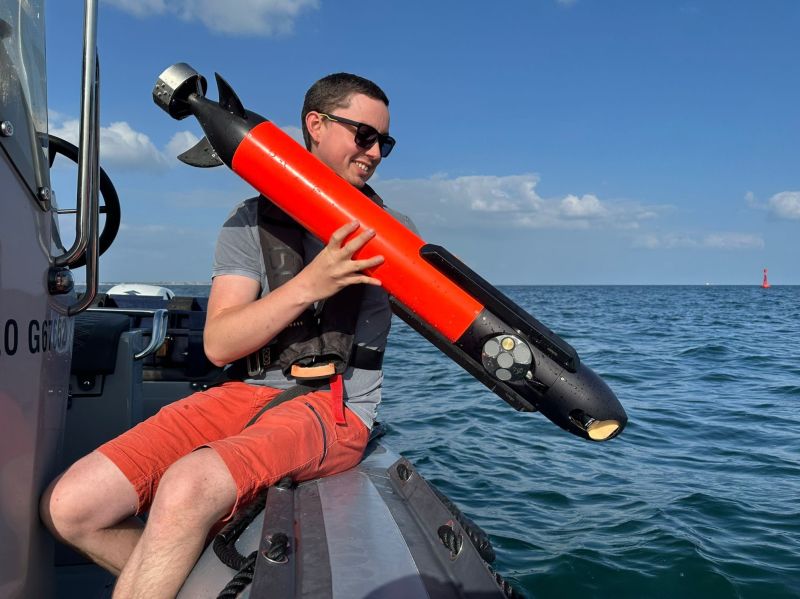
Battery Endurance and Depth Ratings: What to Know Before Choosing an AUV

Specs Can Be Confusing — Here’s How to Read Them Right

When evaluating an autonomous underwater vehicle (AUV) for marine robotics projects, buyers often get caught between two headline numbers: battery endurance and maximum depth rating. These figures can make or break a mission, but they’re also some of the most misunderstood specifications.

At Grey 4 Blue Solutions, we help universities, defence agencies, and industry operators choose the right AUV for their missions. Here’s how endurance and depth ratings really work — and how to avoid costly mistakes when comparing models.


Depth Ratings: Beyond the Marketing Number

Depth rating is more than a headline spec — it’s about operational safety and mission reliability.

  • Coastal & shelf operations (often <100 m): Micro-AUVs like the SEABER YUCO Range, are rated to 300 m, but are widely used in coastal environments for teaching and environmental monitoring.
  • Mid-range AUVs (around 300 m): Suited for offshore energy, infrastructure inspections, and advanced research projects. MARVEL-SCAN is a common choice.
  • Deep-water AUVs (1000–3000 m): Specialised, high-cost solutions such as Teledyne Gavia (500/1000 m) and Kongsberg HUGIN (up to ~3000 m), typically used in defence and large-scale infrastructure surveys.

👉 Pro tip: Don’t buy for the deepest rating on the spec sheet — buy for the depths you operate in 80% of the time.


Battery Endurance: “Up To” vs Real-World

Endurance is often quoted as “up to” a certain number of hours — but real performance depends heavily on operating conditions.

For example:

  • SEABER YUCO & MARVEL Range: up to 10 h at 3 kn, rated to 300 m.
  • SEABER YUCO & MARVEL Rang: up to 6 h at 4 kn (with Li-ion battery), rated to 300 m

Real-world endurance will vary based on:

  • Speed: Doubling speed drastically reduces run time, as propulsion is the dominant energy draw.
  • Payloads: Sensors like multibeam sonar, magnetometers, or CTDs consume extra power.
  • Currents & conditions: Thrusters work harder in strong tides or colder water, further reducing endurance.

👉 Planning tip: Many operators use a 20–30% buffer below the advertised figure when planning missions. It’s not a guarantee — but a practical safety margin.


Matching Specs to Your Mission

Think mission-first, not spec-first:

  • Marine biology surveys & Coastal Inspection → Endurance is more critical than depth. The YUCO-eDNA excels in extended coastal missions.
  • Offshore inspections → Depth is the limiting factor. MARVEL-MBES and MARVEL-SCAN reach infrastructure reliably.
  • Academic research → Flexibility often matters most. Multi-sensor compatibility ensures adaptability across diverse projects.

Why Accuracy Matters

Not all datasheets are created equal. Some spec claims can be overstated, leading to procurement disappointment.

Grey 4 Blue Solutions provides specifications directly from OEM partners like SEABER and CHASING, with no inflated promises. As an authorised SEABER distributor for Australia, we publish provide local support — so you can trust what you’re buying.


Key Takeaways

  • Depth ratings are about mission safety, not bragging rights.
  • Endurance figures are “up to” values — real-world runtime is often shorter.
  • Always match AUV choice to your actual mission profile.
  • Grey 4 Blue is your trusted AUV supplier in Australia, with verified specs and local service.

Ready to Make the Right Choice?

Post Tags :

Share :